Friday, March 18, 2016

Isolation

Sorry for the late update but I've been so busy at work I've hardly had any time to do anything else.

You could say I've been... isolated.

We scientists know our priorities.

Of course, what people don't understand is that we're never really alone.

As Gregori is constantly reminding me.

Our bodies are teeming with bacteria, so much bacteria that if you counted your own cells and then your bacterial cells, you'd discover that you were pretty thoroughly outnumbered.  If that thought horrifies you, never fear!  Most of those bacteria are completely benign and, in many cases, symbiotic with you.  Your immune system isn't so much a defense system as it is a checks-and-balances-style control system, designed to balance the delicate ecology that is you.  Congratulations.  You were a park reserve all along and didn't know it!  Now you have a good excuse to get out of planting a tree next Arbor Day.

Anywho, I've mentioned before my work with gnotobiotics, which is the study of "known life," aka, the aforementioned trillions of bacteria teeming all over you right now.  Gnotobiotics is a tricky business because obviously, it's impractical to try to count bacteria that outnumber us so much, just like we couldn't expect to reasonably inventory every cell in our bodies.  If you think of a body like a reservation and the bacteria like the wildlife, then you can say that anyone who studies gnotobiotics is the jackass trying to count all the birds in the park.  It just doesn't work like that.

So how are we supposed to know what's in us, on us, and around us, and in what amounts, if we can't count it?  This is a riddle with a pretty good answer.  The answer is that counting to zero is really easy, and if you carpet-bomb a wildlife preserve, you will be able to accurately count all the wildlife, and also would probably be the subject of international outcry for a while.

#CecilTheLion  #NeverForget

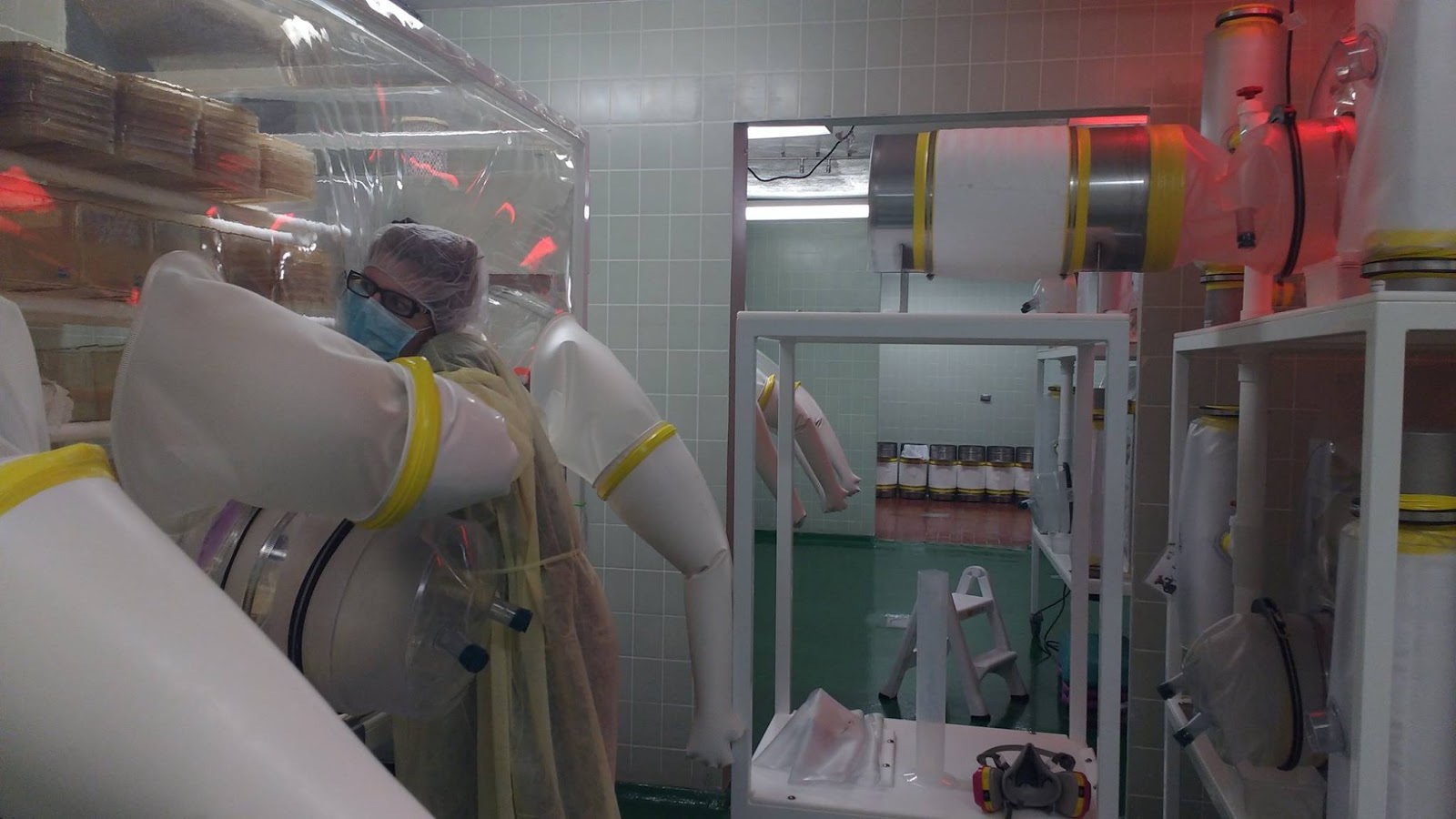
For five months now, we've been eagerly awaiting our germ-free isolators, which are giant plastic bubbles that can be sterilized (remember my carpet bombing metaphor!) and be used to house germ-free mice.  It's a simple concept with a shockingly complex execution.  The isolators need to be built before anything, and they have to be built correctly to ensure that the air flow in and out of them is controlled and filtered.  Then they're sterilized chemically.  The result, if you've done it right, is an inflated bubble of filtered air, with contents that is completely devoid of any and all bacteria, viruses, or fungi, making it a germophobe's wet dream.  Once sterilized, the isolators have to be treated very carefully to maintain sterility; all items are moved in and out of the isolators using a port that mimics a space station air lock, and all items must either be sterilized chemically or mechanically in an autoclave.  All work is done using a large set of heavy white astronaut gloves.  Meanwhile, weekly testing is used to confirm the germ-free status: methods include PCRing mouse feces, swabbing and incubating bacterial plates, and Western blot.  If you've never collected mouse feces while wearing astronaut gloves, then you have no idea just how hard this is.

To be fair, though, all science is hard.

So over the last month, I have been working on setting up our facility, building it from the ground up.  It's a labor of love and I'm delighted to see it coming together.  Below are some pictures.  Enjoy!

First, we enter the lab...


Ignore that sign.  It's actually very safe.  We use goggles and everything.


The "lab" is only where we conduct actual research and process data (which may refer either to actual DNA or to Excel spreadsheets, depending on what day of the week it is).


One of the places I spend a lot of time in within the lab is an anaerobic chamber.  This bubble lacks oxygen and so you can grow gut bacteria within it.  Hence the biohazard sticker.

The chamber is one of the places I test for isolator contamination.  If I swab anything and put it on a plate of media, bacteria will grow.  Here, for example, is a plate I coughed on personally.


But a germ-free chamber, swabbed, will yield no growth.  You can swab the mouse, you can smear its feces around, you can have the mouse spit on the plate... but there's no bacteria.  Nothing grows.  To establish sterility initially can take up to 50 plates to confirm.  My phone is nothing but pictures of plates right now.


But let's start at the beginning.  How do the isolators get set up?  It starts with the delivery of the components... 


It's like Christmas morning in the lab any time we get a big delivery like this.


Next we start setting things up.  Shelves are entered into the isolator and built inside them.  The isolator, a large plastic button, is attached to a round, rigid port that is attached to a table.


I liked this part because I got to use a wrench.

The large isolators and the shelving units were so large I had to climb inside them to set everything up.


In no particular order, we attach gloves, air filters, and ports to the plastic bubbles.  At this point the bubble isn't inflated and everything is still swarming with bacteria.  If you have OCD, feel free to take a break at this time and wash your hands.  It doesn't matter.  You're still teeming with bacteria.  Go ahead and let your pet bird sit in your food.  It doesn't matter.


Attachment points are secured with every mechanism known to man.  Tape, wires, stretched polyurethane, rubber bands, chewing gum... anything to ensure a seal and prevent bacteria from entering.


Next, we start entering supplies.  Some are obvious, like tweezers.  Others aren't.  Things like knitting needles, towels from AutoZone, and colorful stickers have all been put inside the isolators for completely legitimate scientific purposes.


 (Above: note the unassembled shelves in the background!)

Once everything's ready to go, we seal and sterilize the chamber.  How, you ask?  Why, chemicals, of course.  Just look at that chloride-dioxide fog!


Once the decontamination time has been met, we flush the isolator by turning on the air.


All air passes through HEPA filters to ensure no airbourne pathogens get in.  You can make sure air is flowing using ribbons.  I use blue ribbons so that I feel like a winner or sometimes pink for breast cancer awareness.  Also that's just what I happened to have at the time.


Now the isolators, much like my ego, are inflated!  


Confirmation of a successful sterilization takes a week or longer, but from this point on, any items entered must be chemically sterilized or placed into a large, metal cylinder, sealed, autoclaved, and attached and entered.  It's like getting supplies into a space station.


Look how cool it is once set up!


"Why are the lights all weird and red?"  Because first of all, it looks badass, and all evil science lairs need red lights.  Duh.  But also, the red filters protect delicate baby mouse eyes from harsh flourescent lights and make nesting mothers more comfortable.  Within a few weeks of getting our germfree mice, we were greeted with this little jelly bean (on the left)...


A successful, albeit arduous process.  So far, all of my isolators have been sterile on the first try.  I'm six for six on set-up and sterility, and have a colony thirty mice strong, along with three litters of new, germ-free babies!

Now I just have to take care of them forever and maintain that sterility.  Everything is done with gloves and lots of swearing to ensure the best results.


Let it blow your mind for a second.  These isolators are like the void of space.  You could shrink down to any size and you would never encounter even a single virus or living bacteria.  When I ask, "How many organisms occupy this space?" the answer might literally be, "Four.  I observe four mice.  There are no other living organisms even on a microscopic level in that bubble."

Now who's mind freaking whom, Criss Angel?
 
Once the colonies seem stable, I'm hoping to get into some research this summer.  So forgive me if my blog posts become erratic and infrequent... I'm busy doing science.

That's all, folks!

Monday, February 15, 2016

Nike! Also, foot pictures for Gregori!

Yesterday, I ran a marathon.

That's right.  Screw you, asthma.


First, a bit about the historical marathon.  According to legend, when the Greeks beat the Persians in the Battle of Marathon in 490 B.C., a soldier by the name of Pheidippides (also named as Philippides, Thersipus, or Eucles) ran the entire distance from Marathon to Athens, where he burst into the Senate, yelled "νενικήκαμεν!" and then collapsed and died.  Supposedly the distance from Marathon to Athens is the marathon distance of 26.2 miles but this is actually probably incorrect.  See, there's two routes from Marathon to Athens.  One of them is about 21-22 miles, running northwest through steep mountain terrain, and the other is about 25.4 miles, running south and around the mountain.  When the modern Olympics began in 1896, a "marathon" was 25 miles, to represent Pheidippides' route south along the Marathon bay and then west, past Mount Hymettus and Penteli and downhill to Athens.

At some point during the run he lost all his clothes apparently.

Between 1896 and 1924, no one in the Olympics seemed to be able to agree how far a marathon should be.  It changed each game, with the shortest distance being a measly 24.85 miles and the longest being an agonizing 26.56 miles.  But they all stopped drinking in 1924, presumably due to Prohibition, and settled on the 26.22 mile course we now know and love.

Last historical tidbit:  Pheidippides's famous words, "nenikekamen," is the inspiration for the name brand "Nike."  People always say that "Nike!" means victory, but this isn't entirely correct.  Nenikekamen means "We have won" or "we have succeeded."  Thus, "Nike" is not a derived from a noun at all but a verb: νῑκάω, which means "to win."

Now, about my marathon.  This item has been on my bucket list for a while and I have the following positive things to say:
  • I crossed the finish line.
  • I did not shit my pants.
  • My nipples did not bleed.
  • I did not vomit.
  • I did not need to use my rescue inhaler even once, before, during, or after the race.  My breathing was perfect!  

 I ran this marathon without any preparation and so I'd like to take a moment to tell others who plan to do this what I have to report.


5 Tips for How to Train for a Marathon Like a Moron Without Any Training Whatsoever
  1. Invest heavily in your gear.  I got a very, very supportive sports bra, sunglasses, and some imported Swedish insoles for my shoes.  I also had a sweatband for my head, and sweatbands on my wrists so that I could look like Pickles the Drummer from Dethklok.  The wrist sweatbands did nothing, but having good shoes and a good bra absolutely did.  I also got some compression socks for ankle support.  No one explained to me that they cut off circulation and should be worn after the race, so I wore them for the first half and then ripped them off later.
  2. Invest heavily in your diet.  In the week leading up to the race, I stopped drinking caffeine and liquor and focused on "healthy" fats like avocados and walnuts.  I also took fish oil tablets, a small concession to my vegetarianism.  By race day, I was taking 4 pills every 12 hours, for something like 6 grams of omega-3s. 
  3. Use pseudoscience.  I bought a yellow crystal.  As an actual scientist, I don't know if I got the right crystal or not, but since yellow seems like a pretty positive color, I thought it would do in a pinch.  I also did a lot of mental gymnastics to get myself pumped.  For example, I figured that if the first guy who did it died, I only needed to run half as hard as he did and I wouldn't die.  I got some "energy gels" for the race from Clif that are basically caffeine suspended in a cake icing matrix.  I read a lot of articles about running to inspire myself and learned some mantras ("Pain is weakness leaving the body!") and made note of the fact that some dog ran a half marathon without even trying and so I just had to be twice as strong as that dog to do it.
  4. Have a playlist.  Andrew made my playlist for me.  It was upbeat and perfect for running and interspersed with messages from my friends encouraging me, including Jeff from D&D telling me not to bring dishonor from my family, Andrew imitating Obadiah Stane and telling Tony to "finish what he started," and my dear friend Dr. Forbin singing "Go Go Power Puppy... You're a Mighty Runnin' Power Puppy!" to the Power Rangers theme song. 
  5. Tell all your friends.  Talking about the marathon constantly in the days leading up to it ensures that you will be forced to follow through lest they all judge you.  Accountability was a big part of running this race for me; once I'd decided to do it, quitting was no longer an option.
 I also wrote this on my race bib just in case.
I will also say that racing with someone, having low expectations, being in generally good health, and pacing yourself are also good ideas.  But it is absolutely possible if you loathe running and just want to check it off your bucket list.

Here's the route we followed:


Each mile was supposed to be a Los Angeles landmark but the only ones I remember clearly were mile 7 (Silverlake, where my mechanic is), 10 (the Hollywood walk of fame), and 11 (Grauman’s Chinese Theater, featured in Iron Man 3).

As we scooted off, I felt good.  I had once run eight miles and felt great so I figured I would just do that three times and be good to go.  Unfortunately, Google Map miles appear to be much shorter than Official Marathon miles because it seemed to take forever to get to mile 1.  I was pacing myself at a slow jog but by mile 5 I felt tired.  Every single mile, a gamut of volunteers shoved water and Gatorade at us, yelling at us to hydrate, and I shot the water like whiskey, unaware that this would unsettle my stomach.  I began to switch between bouts of walking and jogging because my asthma medication can cause tachycardia if I push myself too hard, and I knew if that happened I would be out of the race entirely.  Also the Gatorade gave me a bloated feeling; my insides were liquefying.  Sometime around mile 7 or 8 I had to pee, desperately.  I found a Port-a-Loo, waited in line with 4 other women for five to ten minutes, said "screw it," and squatted and peed right there.  Relieved that they weren't the ones to suggest this measure, all the other women did the same, and we went back to the race.  My urine was clear, a good sign.  I wondered why everyone said marathons were hard because I was obviously owning this race like a total badass.

By mile 9 or 10 I felt pleased that I had gone father than ever.  I was in the double digits!  Unfortunately, with regards to things that are doubled, my bad ankle was beginning to act up.  See, I have Accessory Navicular Syndrome, and my extra navicular bone isn't meant to be weight-bearing.

I have 207 bones in my body! 

Sorry about all the foot pictures today!

My other foot, compensating for it, began to feel weird; my Achilles's tendon felt like it was made of taffy and was pulling much farther than it should.  Finally, around mile 13, my bad right foot collapsed.  It refused to bear any weight.  I tried to walk it off, leaning on Andrew and limping/hopping, but it was useless.  We walked back to a CVS we'd passed and bought Ace bandages.  I wrapped up the foot for support and removed the compression socks to improve circulation, and we limped on.  It was basically like having a prosthetic because the foot was useless.

Oddly, though, shortly after this disastrous setback, we felt a lot better.  We began our jog-and-walk routine again.  We were more than halfway there and aside from our feet feeling like Hamburger Helper and our legs being sore, we both felt we could finish strong.  At mile 19, I felt hypnotized, like I was in a trance, like I was a zombie.  Around us, everyone was shuffling dutifully forward.  The sun was high in the sky and beating down on us, and we dumped water on ourselves as often as possible.  I ran the last 6 miles at a crawl, but damn it, I ran them without stopping.  Actually I was scared of stopping; my body felt like it was under a spell and if I broke it I would never walk again.

Those last six miles were a death march.  There was no "wall," just a gradual realization that I lacked the capability to either stop my legs from moving or to move any faster; I was jogging at perhaps 3-4 miles per hour, more of a walk that involved a jogging motion, and my body was mechanical and powered by determination.  I had been eating ice and sipping water at every mile but I was no longer urinating at all because of the sweat.  Everything below the waist ached.  Andrew and I weakly mumbled things to each other like, "Pain is temporary; glory is forever," and "You're doing great, we're almost there," and "This is the end, let the sweet embrace of death take me, tell my wife I love her."


The ocean, which was the final destination, only appeared in the last mile.  We felt the breeze by mile 23 but the ocean only came into view by the last mile.  Aching, we shuffled forever, not really happy or sad or anything except for numb, mindless running machines.  We saw the finish line.  It approached faster than we could have expected, and we joined hands and ran over it together.  Our time was seven hours and twenty minutes.  This isn't a good time but, considering my foot crashing out and our total lack of preparation, we were pleased.  Pleasant volunteers put heavy medals around our necks, and we wandered around in a daze with our medals, unable to stop moving our legs.  When we finally sat for a few minutes, getting up was nearly impossible.

Due to the weight of the medals.

Once home, Andrew soaked in the bath while I popped three blisters the size of quarters.  One had erupted twice already and reformed, making my toe look like it had some sort of terrible disease.  Perhaps gangrene.  The other two blisters, throbbing like fluid-filled bubble wrap, hadn't yet popped; I lanced them and they squirted fluid in a thin but rather powerful stream out before slowing to slow, viscous drip.  I have since lanced them three more times because they continue to fill.

 Look at these fuckers!

Legend has it that there was once a toe here.

Am I sore today?  "Sore" isn't quite accurate.  It would be better to say I'm "stiff."  My legs don't bend right anymore and I walk like Frankenstein's monster now, but overall I feel pretty good.  If it weren't Presidents Day, I would be able to go into work.

So overall I'm going to give this experience a 7.5/10 and say that I might just do it again, and actually train so that I can finish it in under 6 hours.

Noteworthy signs I saw along the way:
  • Thanks for running so I could hold this sign.
  • This seems like a lot of work for a free banana.
  • Run like you stole something!
  • You're beating everyone behind you.
  • Worst parade ever.
  • [accompanied by a picture of Grumpy Cat] I ran once.  It was awful.
  • Because 26.3 miles would be ridiculous.
  • Kick asphalt!
  • That outfit makes your butt look fast.
  • If Trump can run, so can you!